
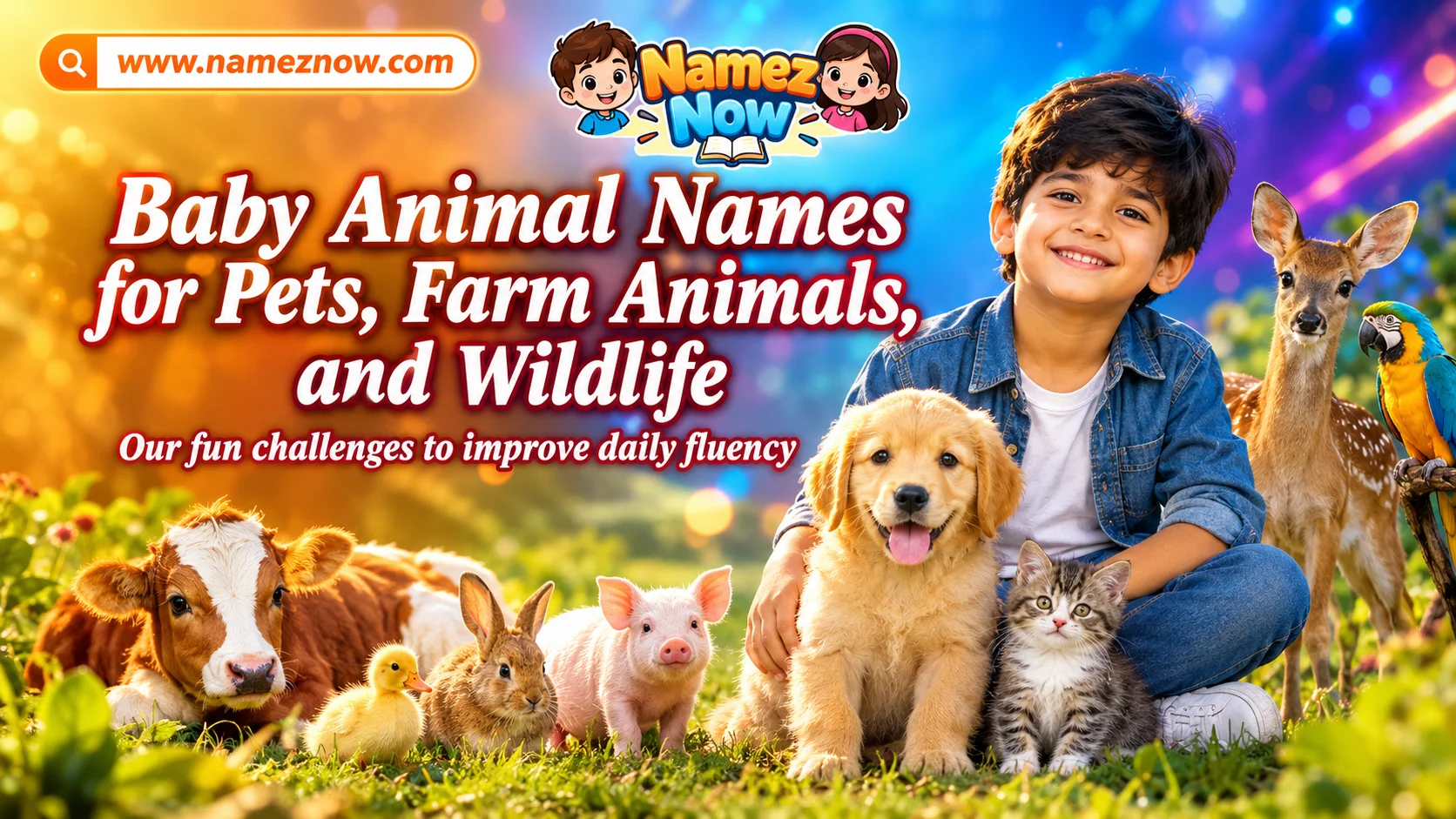
Animals use many different names for their young, and learning baby animal names helps us describe each animal more clearly. People commonly use words such as puppy for a young dog, kitten for a young cat, calf for a young cow, and lamb for a young sheep. Other baby animal names, such as fawn, cygnet, joey, and leveret, may sound less familiar but add useful detail to animal vocabulary.
Parents, teachers, students, writers, and animal lovers can all benefit from learning these terms. Children often learn simple examples such as puppy, kitten, chick, and duckling first. As they explore more animals, they can discover specific words for wildlife, birds, reptiles, amphibians, and other creatures.
Find Your Perfect Name
Explore thousands of unique names with real meanings — instantly, and completely free.
The right term can also make writing more natural. Instead of saying “a baby deer walked through the forest,” you can write “a fawn walked through the forest.” The second sentence gives readers a more precise image without adding unnecessary detail.
Baby Animal Names for Pets and Farm Animals
People often learn the most familiar baby animal names through pets and farm animals. Families talk about puppies and kittens at home, while farmers regularly use terms such as calf, lamb, kid, piglet, and foal. These words also appear in children’s books, school lessons, animal stories, and everyday conversations.
Common terms for young domestic animals
| Animal | Baby Animal Name |
|---|---|
| Dog | Puppy |
| Cat | Kitten |
| Rabbit | Kit or bunny |
| Cow | Calf |
| Goat | Kid |
| Sheep | Lamb |
| Pig | Piglet |
| Horse | Foal |
| Donkey | Foal |
| Chicken | Chick |
| Duck | Duckling |
| Goose | Gosling |
| Turkey | Poult |
| Pigeon | Squab |
| Swan | Cygnet |
A puppy refers to a young dog, while a kitten refers to a young cat. These two words have become part of everyday language, so most people recognize them immediately. Children also encounter these terms early because families, books, cartoons, and classroom activities often feature puppies and kittens.
A young goat has a different name: kid. The word can confuse new learners because people also use kid to mean a child. Context makes the meaning clear. When a sentence talks about a goat, farm, herd, or animal, readers understand that kid refers to a young goat.
People call a young horse a foal. The same word can describe a young donkey or zebra in suitable contexts. As the animal grows, other terms can describe its age or sex more specifically.
Rabbits offer another useful example. People often say bunny when they talk about a young rabbit, especially in casual or affectionate conversation. Kit also describes a young rabbit. Writers can choose either term depending on the tone and audience.
Baby Animal Names for Wild Mammals
Wild mammals have many interesting names for their young. Some terms appear frequently in wildlife programs and nature books, while others mainly occur in specialist or educational writing.
Young lions, bears, deer, and elephants
People call a young lion a cub, and they also use cub for the young of several other large mammals, including bears, tigers, leopards, and cheetahs. A young deer has a more specific name: fawn. People use calf for young elephants, giraffes, rhinoceroses, and hippopotamuses as well as young cattle.
| Animal | Baby Animal Name |
|---|---|
| Lion | Cub |
| Tiger | Cub |
| Bear | Cub |
| Leopard | Cub |
| Cheetah | Cub |
| Deer | Fawn |
| Elephant | Calf |
| Giraffe | Calf |
| Zebra | Foal |
| Rhinoceros | Calf |
| Hippopotamus | Calf |
| Kangaroo | Joey |
| Koala | Joey |
| Wolf | Pup |
| Fox | Kit or cub |
| Coyote | Pup |
| Seal | Pup |
| Otter | Pup or kit |
| Hare | Leveret |
Kangaroos and koalas provide another memorable example. People commonly call their young joeys. The word also applies to the young of other marsupials, so it does not belong only to kangaroos.
People call young wolves pups, and wildlife writers often use the same term when they describe wolf families and packs. Foxes can take the names kit or cub, while young coyotes commonly take the name pup.
A young hare has the special term leveret. Most people encounter the word less often than fawn or cub, but it can add useful variety to nature writing. Writers who create stories about forests, fields, or wildlife can use such specific vocabulary when the context supports it.
Baby Animal Names for Birds
Birds have many names for their young, and chick provides one of the most familiar general terms. People also use species-specific words such as duckling, gosling, cygnet, eaglet, and owlet.
Chicks, ducklings, goslings, and fledglings
A baby chicken is a chick, while a baby duck is a duckling. A young goose is a gosling, and a young swan is a cygnet. People call a young eagle an eaglet and a young owl an owlet.
| Bird | Baby Animal Name |
|---|---|
| Chicken | Chick |
| Duck | Duckling |
| Goose | Gosling |
| Swan | Cygnet |
| Eagle | Eaglet |
| Owl | Owlet |
| Turkey | Poult |
| Pigeon | Squab |
| Dove | Squab |
| Peacock | Peachick |
| Penguin | Chick |
| Ostrich | Chick |
| Falcon | Eyas |
These words help writers describe birds with greater accuracy. For example, a nature story can describe a cygnet swimming beside an adult swan or an eaglet waiting inside its nest. The specific term gives the reader more information without requiring a long explanation.
Bird vocabulary also includes terms that describe growth stages. A nestling remains in or near its nest and still relies heavily on its parents. A fledgling has developed enough to leave the nest and start learning how to fly, although it may continue to depend on adult birds.
Teachers can use these differences to explain how birds grow. Students can learn chick as a general word and then compare it with duckling, gosling, eaglet, and cygnet.
Baby Animal Names for Reptiles and Amphibians
Reptiles and amphibians often use different vocabulary because their young can develop in ways that differ greatly from mammals. Words such as hatchling, tadpole, and larva describe specific stages of development rather than simply naming a smaller version of the adult.
Hatchlings and tadpoles
People commonly call a newly hatched snake a hatchling. The same word can describe a young turtle, tortoise, crocodile, alligator, or lizard after it emerges from an egg. The word focuses on the animal’s stage of development rather than its species.
Frogs and toads follow a different path. Their early life begins with a tadpole, which looks very different from an adult frog or toad. As the tadpole develops, it grows legs, changes its body structure, develops lungs, and gradually loses its tail.
| Animal | Young Animal Term |
|---|---|
| Snake | Hatchling |
| Turtle | Hatchling |
| Tortoise | Hatchling |
| Crocodile | Hatchling |
| Alligator | Hatchling |
| Lizard | Hatchling |
| Frog | Tadpole |
| Toad | Tadpole |
| Salamander | Larva |
| Fish | Fry |
| Butterfly | Caterpillar |
| Moth | Caterpillar |
Young fish often go through several developmental stages, and people commonly use fry for very young fish. The exact terminology can vary among species, but fry provides a useful general term.
Butterflies and moths also show why the phrase “baby animal” does not always describe a miniature adult. A caterpillar represents the larval stage of a butterfly or moth. Later, the insect undergoes metamorphosis and develops into its adult form.
Cute Baby Animal Names for Pets and Characters
People sometimes search for baby animal names because they want cute names for pets, fictional characters, classroom mascots, or social media posts. In these cases, the goal differs from learning the biological term for a young animal.
Sweet names for little animals
Short, friendly names often work well for small pets and animal characters. Ideas such as Baby, Tiny, Bean, Button, Pip, Peanut, Nibbles, Coco, Teddy, Sunny, Snowy, Fluffy, Paws, Bunny, Cubby, and Mochi can create a soft and playful feeling.
A pet’s personality can guide the choice. Nibbles might suit a rabbit that constantly explores its food bowl, while Pip could fit a tiny, energetic kitten. Teddy may suit a fluffy puppy, and Snowy could work well for a white cat or rabbit.
Physical features can provide another source of inspiration. Owners might choose Paws for an animal with large feet, Fluffy for a long-haired pet, or Peanut for an unusually small companion. These names do not need to follow official animal terminology because they function as personal nicknames.
Social media users can also build captions around these names. A short caption such as “Meet little Pip” sounds warm and natural, while a longer nickname may become difficult to repeat. A simple name often gives the pet a stronger identity across Instagram, TikTok, Snapchat, and other platforms.
How to Choose the Right Baby Animal Term
The best baby animal term depends on the species, the audience, and the purpose of your writing. Everyday conversations usually favor familiar words such as puppy, kitten, chick, and lamb. Educational articles can introduce less common vocabulary when the writer explains the meaning clearly.
Choose words that fit your audience
Children can learn animal vocabulary more easily when teachers start with familiar terms. After students understand puppy and kitten, teachers can introduce fawn, foal, joey, cygnet, and eaglet. This approach helps learners connect new words with animals they already know.
Writers should also distinguish between species-specific terms and general developmental terms. Duckling identifies a young duck, while chick can describe a young bird more generally. Hatchling describes an animal that has recently emerged from an egg, so several reptile species can use the term.
A useful group of common terms includes puppy for a young dog, kitten for a young cat, calf for several mammals, cub for animals such as lions and bears, fawn for a young deer, foal for a young horse, joey for a young kangaroo, chick for a young bird, duckling for a young duck, gosling for a young goose, and cygnet for a young swan.
Writers do not need to use technical vocabulary in every sentence. Familiar language often communicates better, especially when children or general readers make up the audience. Introduce an uncommon term once, explain it briefly, and then use it naturally.
Frequently Asked Questions About Baby Animal Names
What is a baby dog called?
People call a baby dog a puppy. The word describes a young dog and works naturally in everyday conversation, educational writing, and pet-related content.
What is a baby cat called?
People call a baby cat a kitten. The term commonly describes young domestic cats and remains one of the most familiar animal words.
What is a baby deer called?
People call a baby deer a fawn. The term appears often in nature writing, wildlife descriptions, and children’s stories about forests and animals.
What is a baby horse called?
People call a baby horse a foal. The term also applies to young donkeys and zebras in appropriate contexts.
What is a baby goat called?
People call a baby goat a kid. The surrounding animal context distinguishes this meaning from the everyday use of kid for a child.
What is a baby elephant called?
People call a baby elephant a calf. Several other large mammals also use calf as the common term for their young.
What is a baby kangaroo called?
People call a baby kangaroo a joey. The word also describes the young of several other marsupials.
What is a baby swan called?
People call a baby swan a cygnet. This specific term distinguishes a young swan from the more general word chick.
What is a baby frog called?
A young frog begins life as a tadpole. The tadpole gradually develops the features of an adult frog as it grows.
What do people call a baby bird?
People commonly call a baby bird a chick. Individual species can use more specific terms, including duckling, gosling, eaglet, and cygnet.
Does every animal have a special name for its baby?
No. Some animals have unique terms for their young, while others use general words such as baby, young, juvenile, hatchling, or chick. The terminology depends on the species and context.
Final Thoughts on Baby Animal Names
Learning baby animal names helps readers describe animals with greater accuracy and variety. Common words such as puppy, kitten, lamb, calf, fawn, foal, cub, joey, chick, duckling, and cygnet each identify a particular type of young animal.
These terms can help children build vocabulary, help teachers create better animal lessons, and help writers create more natural descriptions. Pet owners can also use the words as inspiration when they choose nicknames or create social media content for their animals.
The easiest way to remember the vocabulary involves connecting each term with the animal itself. Think of a puppy beside a dog, a kitten beside a cat, a fawn beside a deer, a joey with a kangaroo, and a cygnet swimming with a swan. Once you connect the word with the animal, the terminology becomes much easier to remember and use naturally.

Umm ul Baneen
Passionate about researching and creating meaningful, unique, and creative names for readers around the world.
View Full Profile →